
Introduction
This Article offers a picture of women’s lifetime exercise of their procreative power in the United States.
The importance of the portrait is this: Rather than focusing on one or another procreative choice or event (such as abstinence, birth, sterilization, abortion, or the use of condoms, hormones, IUDs, or natural family planning), by this or that subgroup (for example, by ethnicity, income, race, or religion), this portrait presents the interrelationship of the choices and experiences that constitute a human procreative project over a woman’s lifecycle. “Project” is the right word since the portrait shows enormous purposeful activity and sustained effort.
The parameters of this procreative project include a capacious fecundity, potent throughout the entire year, extending over decades of life, lengthened by an ever-earlier puberty and good health into middle age. This project is powerfully fueled by an incessant male and female sexual instinct that enhanced health and well-being further unleashes throughout this period and beyond. However, reason and felt moral obligations constrain this fecundity: duties of responsible parenthood to love, educate, and support the children one brings into the world; duties to one’s procreative partner; duties to one’s community and to our collective posterity; and a duty to care for oneself (one’s health, well-being, and other life projects).
The self-regulation of this procreative power has a constitutional dimension that the Supreme Court identified in 1923. In Meyer v. Nebraska,[1] the Court recognized a right, subject to the police power, to try to establish a way of life and to practice some common calling to support that way of life. This right includes the establishment of a marriage and a family and the raising of children, according to one’s chosen beliefs. Theoretically, in this fourfold constitutional regime of marriage, market, religion, and state, marriage (and family) constitutes an institutional sphere apart from the state and, being “older than the Bill of Rights—older than our political parties,”[2]—preexists it. This separate (and not subsidiary) sphere oversees procreation, apart from the demands of the state, and begins to shape the next generation, one by one in unique families that inculcate values and prepare children for personal and religious “obligations the state can neither supply nor hinder.”[3] The family thus underwrites the individuality upon which a constitutional republic depends. Recognizing this private sphere mostly required the Court to acknowledge facts as they are: that individuals pursue happiness privately within relationships, marriages, and families, based on choices made within their hearts. The law’s primary role is to protect adult consensual choice and to interfere coercively only in exceptional cases of harm.[4] The Court has more recently recognized that an individual’s self-regulation of procreation is absolutely central to shaping a way of life and to choosing those intimate relationships in which a way of life is built, the deepest core of identity is constituted, and happiness is pursued.[5]
By depicting the procreative choices women in the United States make as they lead their lives, the following empirical portrait also contributes to describing what acts the constitutional doctrine of procreative liberty should protect. The Supreme Court clearly asserted the close relationship of such behavioral data to doctrine in the affiliated setting of self-defense. The holding in District of Columbia v. Heller[6] turned entirely on the Court’s inquiry into the daily lives of Americans: “[T]he American people have considered the handgun to be the quintessential self-defense weapon . . . . [H]andguns are the most popular weapon chosen by Americans for self-defense in the home, and a complete prohibition of their use is invalid.”[7] The Court’s methodology of inquiring into chosen practices in daily life to define liberty may be referred to as an anthropology of rights.[8] This study of procreation seeks to contribute to such an anthropology.
The portrait offered here is also a response in its particular subject area to statistician Edward Tufte’s general challenge to develop complex visual presentations of data in order to convey information in a more illuminating way.[9] The following graphs are preliminary in nature, and the reader is invited to help develop and enhance them further. Thus, the graphs aim to depict the life course of procreative choice for both normative and empirical purposes.
I. Reproductive Choice Across the Life Course: The Basic Picture
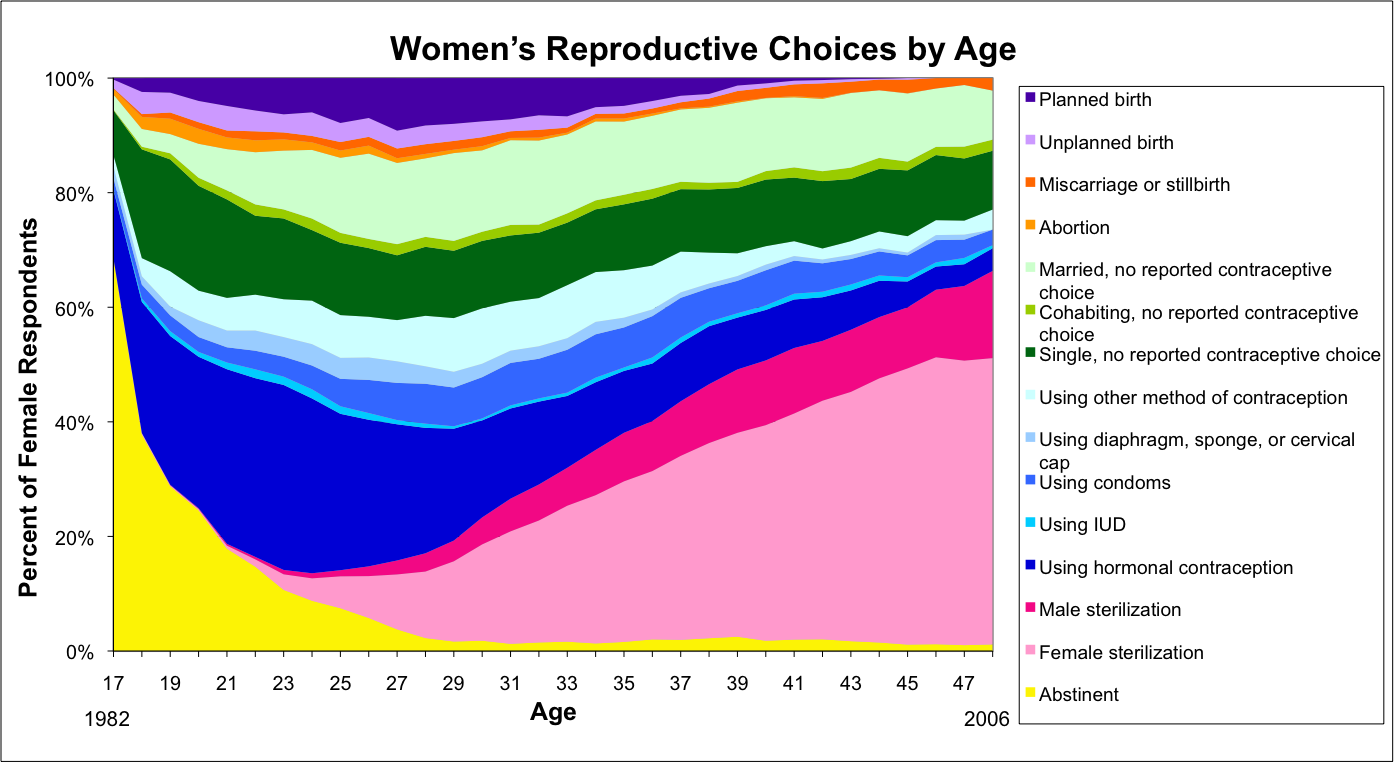
Figure 1 describes the procreative choices made by a single cohort of women from 1982 to 2006 during almost all of their childbearing years. It is based on data from the National Longitudinal Survey of Youth 1979 (NLSY79), a nationally representative sample of 12,686 young people, ages fourteen to twenty-one in 1979, who were interviewed every year from 1979 to 1994 and during even-numbered years from 1994 through 2006. Figure 1 begins with 1982, when the cohort of women were ages seventeen to twenty-four, because 1982 is the first survey year that included questions regarding use of contraceptives.
Figure 1 indicates the percentage of women each year who reported being in one of the following procreative categories: had a planned birth,[10] had an unplanned birth, had a miscarriage or stillbirth,[11] had an abortion, reported no use of contraceptives, used a method of contraception other than sterilization (divided into five categories by type of method[12]), became or continued to be surgically sterilized,[13] or was abstinent.[14]
Figure 1
0–12.5 (avg. menarche)–17 ← 9 → 48–51.5 (avg. menopause)–80 (avg. life)
at ages 20–27 median number of acts of intercourse/month: circa 5[15]
What is there to see in this visual representation? How may it be interpreted?
Throughout much of her life, a woman is confronted with the challenge of regulating her own fertility. The magnitude of this primary human project and the sheer effort of individual choice and responsibility it demands are visible.
Horizontally: Almost all of a woman’s fertile life is encompassed in data ranging from ages seventeen to forty-seven. At the beginning of the twentieth century, fertility might have occupied as much as 60 percent or more of a woman’s life in the healthiest of countries. Now, however, it occupies very roughly 40 percent.[16] This fertile period still occupies a larger portion of her life than her formal education and very possibly her marriage.
Vertically: The picture shows the continuing and extraordinary efforts women undertake in making procreative choices. Most such choices involve avoiding or delaying procreation. By the numbers in any one year, birth is the minor story. Of course, giving birth is a life-altering and life-occupying event that continues all her remaining days.
To ensure that they do not give birth, some women avoid heterosexual intercourse despite the pressures of sexuality and need for human contact.[17] Others take hormone pills, receive hormone injections, have IUDs inserted in their womb, or undergo surgical sterilization. Many employ condoms on a consistent basis or use other methods. A few carefully time intercourse under the discipline of natural family planning despite the difficulty and unreliability of this method.[18] And across the fertile lifecycle, women have children at a rate of population replacement or near to it, and along the way brave the disappointments of miscarriage and stillbirth.
The use of sterilization stands out as evidence of the determination to exercise dominion over fertility. In their twenties, more than half of women employ temporary means of controlling fertility to postpone childbearing, to space children, or to limit the size of families. In their thirties, women increasingly resort to permanent sterilization (or reliance on a partner’s vasectomy) despite the availability of other effective means of birth control. By their mid to late thirties, sterilization is women’s predominant procreative choice, despite decreasing fertility and some waning of the sexual instinct, both of which reduce the likelihood of pregnancy. The fact that women express this determination to halt procreation as they mature and after they have children suggests that this decision is informed and entitled to the respect owed to those who know something of life.
As part of this strenuous effort to regulate fertility, abortion serves as a backup method, consistently employed throughout the entire fertile life of women.[19] It is in no way confined to the very young who, some believe, cannot appreciate the facts of pregnancy and childbirth; to the contrary, grown women across their fertile years, with prior experiences of pregnancy, of children, and of marriage, have abortions.[20]
Considering abortion and sterilization together as determined decisions not to procreate,[21] one is again led to question the stereotype of abortion as primarily a young and inexperienced decision. The reduced number of abortions as women age appears to be the result of sterilization (and perhaps the greater effectiveness of other forms of birth control that sometimes accompanies maturity and more stable relationships). One might suggest that mature women would have more abortions if they hadn’t already sterilized themselves.
The incidence of abortion in Figure 1 offers a useful perspective on the extraordinary attention the subject receives in the United States. It shows that abortion is but one method, and a comparatively rare one, among a wide range that women determinedly use to avoid procreation.[22] It appears to be used largely as a backup to all the other efforts women make.
But unlike sterilization, abortion does not irrevocably foreclose future procreation; and thus abortion preserves and protects a woman’s opportunity to mother at a later time.[23] As indicated above but not visually represented in the graph, many women who have an abortion later go on to birth children.
Figure 1 also shows that the portion of married women in their thirties and forties who report not using contraception remains relatively constant, even as childbirths drastically decline by age forty and largely come to a halt after age forty-five. Reduced fertility may lead some in this group to conclude, especially with the backup of abortion, that no contraception is necessary to avoid procreation. But others may want more children and keep trying despite their reduced fertility. The availability of abortion presumably reassures them that they can do so and still avoid the increasingly severe risk of pregnancy-related diseases and fetal abnormalities.
Finally, it may be noted here that the categories of noncontracepting married, cohabiting, and single women, colored in shades of green in Figure 1, are relatively large, but their characteristics are not clearly pictured, as discussed in Part II.[24]
II. The Representativeness of the Basic Picture: Reproductive Choice by Women of Childbearing
Age in 2002
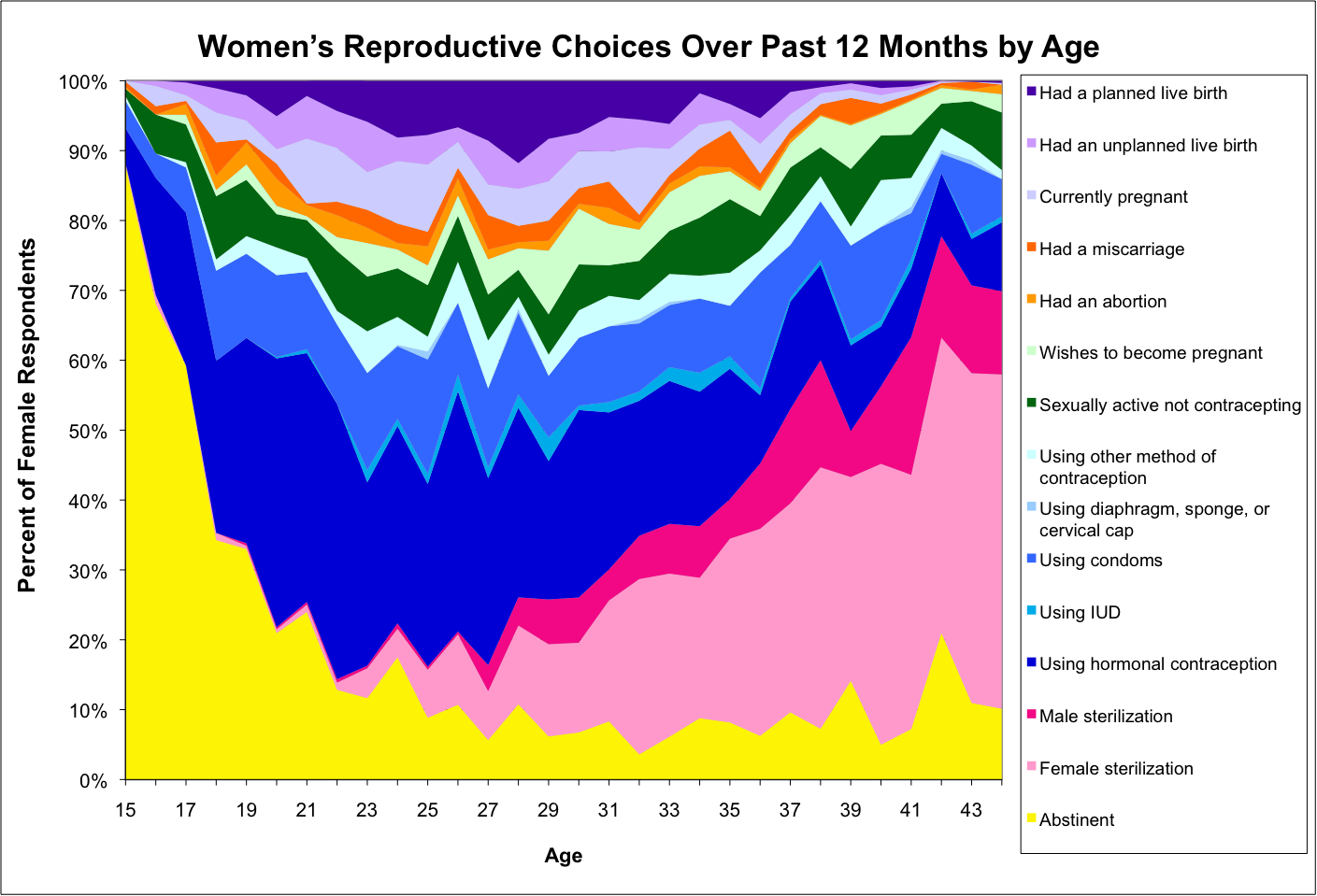
While Figure 1 shows the choices that a single cohort of women made over their fertile years, Figure 2-S (S for smoothed) shows the choices, defined in somewhat similar categories, of a sample of women of child-bearing age reported in 2002. Figure 2-S relies on data gathered from female respondents during cycle six of the National Survey of Family Growth (NSFG), a nationally representative sample of the noninstitutionalized U.S. population, ages fifteen to forty-four.[25]
The NSFG sample size in each category at each age pictured here is relatively small. As a result, there is a fair degree of variation across proximate age groups. To see what the patterns might look like if the sample size were larger (with the presumptive result of less variation between adjacent age groups), a value for each procreative category at each age was constructed using a three-year moving average.[26] Figure 2-S shows the results of this data smoothing. Absent such averaging, the graph would appear jagged as a result of noise arising from variation between any two consecutive ages of relatively small sample size.[27]
Figure 2-S
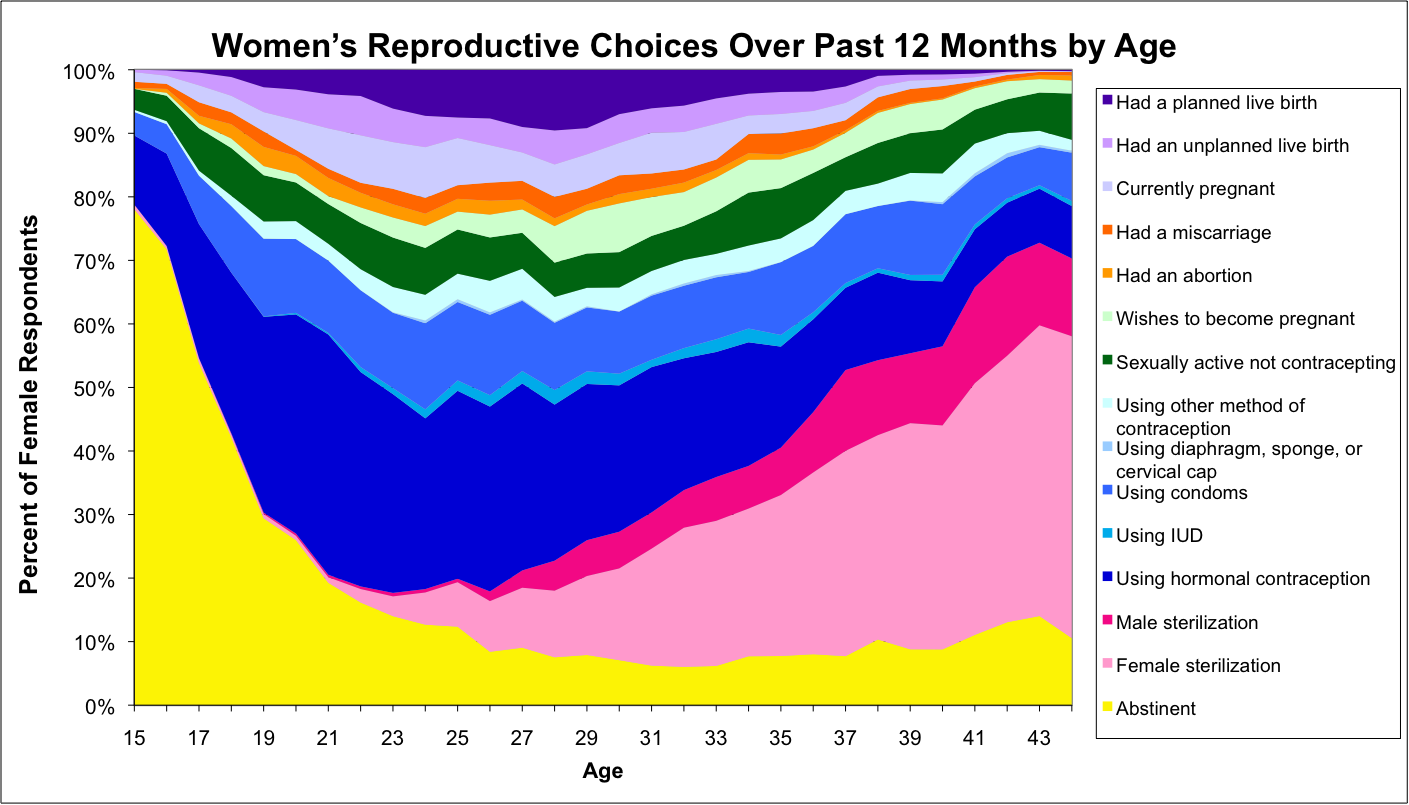
The similarity of Figures 1 and 2-S mutually support the accuracy of the overall picture they paint.
But despite the similarity, there are noticeable differences between their representations of the two different sets of women respondents.[28] These differences arise in part because the NSFG represented in Figure 2-S employs three useful categories not found in Figure 1. First, the “sexually active not contracepting” Figure 2-S category is more usefully defined, although substantially smaller, than the three noncontracepting (whether sexually active or not) married, cohabiting, and single categories in Figure 1. Two additional NSFG categories, “wishes to become pregnant” and “currently pregnant,” presumably also include women who could have been classified as noncontracepting in Figure 1.
Finally, others in Figure 1’s noncontracepting groups presumably would shift[29] to the much larger abstinent category of Figure 2-S. This abstinent category, found in both NLSY79 and NSFG, involves the most noticeable discrepancy between the two figures. Figure 2-S shows continuing use of abstinence throughout the lifecycle in contrast to the tapering off of abstinence at around age twenty-seven in Figure 1. While 98 percent of women ages twenty-five to forty-four have had sexual intercourse with a man at some point in their lives,[30] among NSFG women over age twenty-seven, nearly 10 percent nearly 10 percent are heterosexually abstinent in any given year. Methodological differences in eliciting and categorizing responses (as explained in the next two paragraphs) can account for the difference in abstinence between the two figures, and suggest that Figure 2-S is more accurate than Figure 1 regarding abstinence.
In the NSFG survey in Figure 2-S, if a woman indicated she had ever had sexual intercourse with a man, she was then asked a series of questions about her sexual activity, contraceptive use, and sterilization within the past year. Women were classified as abstinent if they reported no sexual intercourse ever or in the three months before the interview. Furthermore, the 62 percent of women who reported being sexually active and using contraceptives were then grouped by their most effective contraceptive method, using the same five categories as NLSY79 in Figure 1.[31] Respondents who said they were sexually active but not using a method of contraception were also asked if they wished to become pregnant, thus distinguishing those women who wanted to be pregnant and were actively trying to conceive (4.2 percent) from those women who were sexually active but not contracepting (7.4 percent) and therefore at risk of an unintended pregnancy.[32]
By contrast, NLSY79’s method of identifying abstinence is problematic, and, as a result, Figure 1 may look as if it equates abstinence with virginity. Only in 1983, 1984, and 1985 were respondents asked specifically about their age at first intercourse and how many times they had had sex in the past month. As a result, lifetime and last-month abstinence could be inferred in those years. But after 1985, women had the option of reporting abstinence only as one method of birth control and only if they first self-identified as using birth control. It is plausible that, post-1985, many women who were not sexually active during the month preceding the interview would simply have indicated that they were not using any method to prevent pregnancy. Consequently, they would not have been asked the series of birth control questions that would have allowed them to report abstinence. Thus, the NLSY79 category “single no reported contraceptive” not only includes women whom the NSFG would classify as “sexually active no reported contraceptive” but also includes women the NSFG study would identify as “abstinent” or “wishes to become pregnant.”[33] Consistent with this understanding is the NLSY79’s dramatic drop-off in reported abstinence at around age twenty-seven. This age overlaps with the last time the relevant question about frequency of intercourse was asked in 1985, when women in the cohort sample were between the ages of twenty and twenty-seven.
Finally, with regard to the NSFG abstinent group, it should be noted that abstaining from heterosexual intercourse does not mean abstaining from all sexual contact. This is clear for teenagers, and it remains the case later in life (although among married persons, only 0.09 percent did not have intercourse in the last year and among the much smaller group of cohabiters, only 1.9 percent did not). It bears recognizing that the group identified in Figure 2-S as abstinent includes those women who regulated their fertility by exclusively engaging in same-sex relationships.[34] In the twelve months prior to their NSFG interview, 1.3 percent of women reported having exclusively same-sex sexual contact and thus were classified as heterosexually abstinent.[35]
In conclusion, the picture in Figure 2-S is probably the more accurate of the two, especially regarding abstinence after age twenty-seven. Its greater specificity with respect to the several variables noted above only reinforces the primary interpretation made in discussing Figure 1: that women are engaged in a continuing and pervasive project of choice regarding their fertility. Despite this greater accuracy of Figure 2-S, the rarity and importance of good longitudinal data counsel the retention of Figure 1, along with Figure 2-S, for developing a portrait of procreative choice.
III. Correcting the Pictures’ Abortion Rates
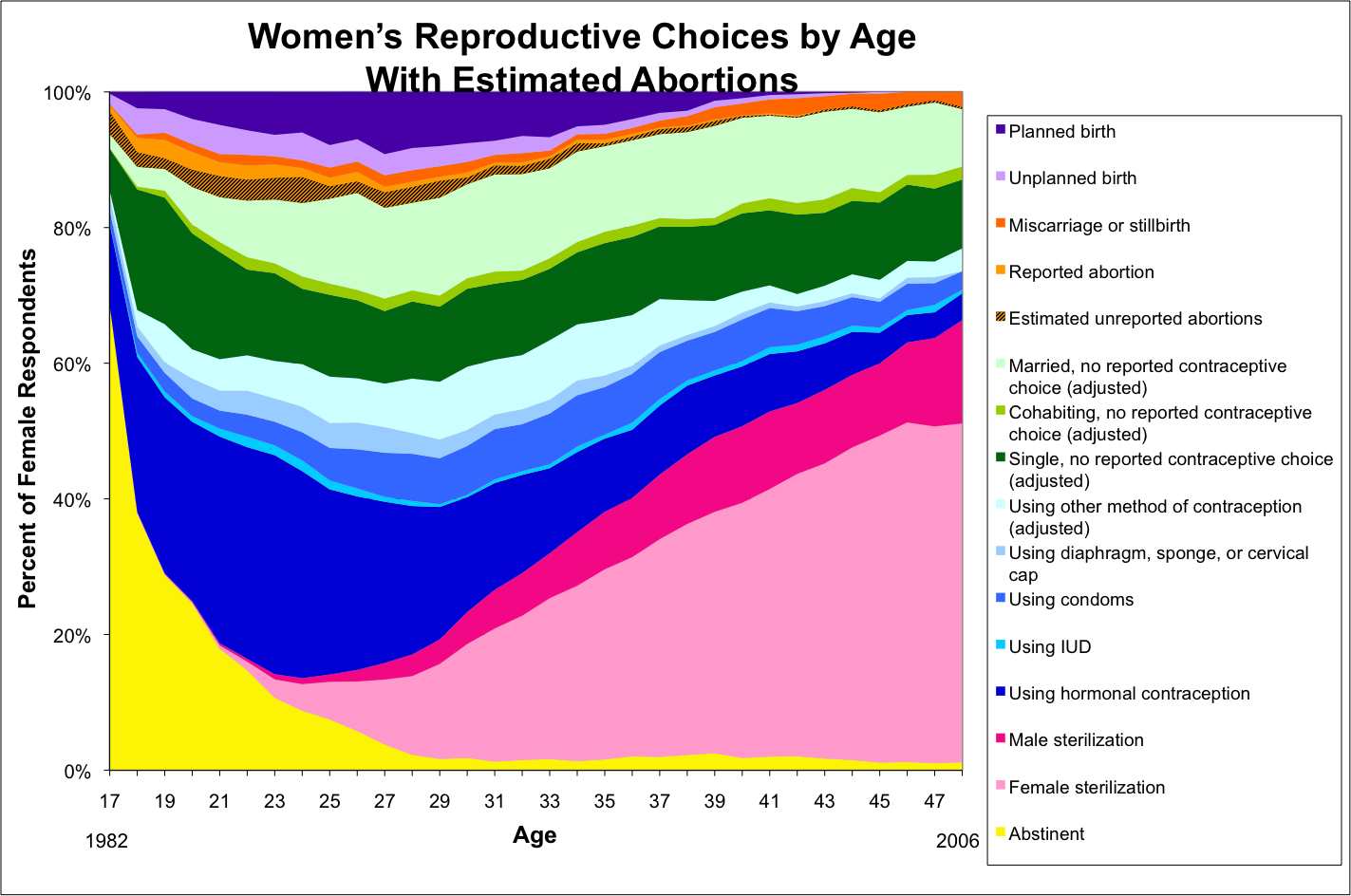
In Figure 1, at most ages, fewer than 20 percent of reported pregnancies end in abortion. This abortion rate is half the widely accepted abortion rate of four out of every ten pregnancies reported by Finer and Henshaw.[36] Similar underreporting appears in Figure 2-S.
To correct this presumed underreporting of abortion in the NSFG data, Figure 2-S-EA (estimated abortions) pictures an estimated true abortion rate for the smoothed data of Figure 2-S. The estimated abortion rate was developed as follows: The percentage of women reporting an abortion at each age was subtracted from the 2000 rate for that age group reported by Finer and Henshaw. The resulting difference constituted the estimate of unreported abortions. Adding this data to Figure 2-S required reducing the size of other categories. The respondents most likely to have underreported abortion were assumed to be sexually active women most at risk of an unintended pregnancy: those who reported no contraceptive use or reported using a less effective contraceptive method. Accordingly, two-thirds of the estimated unreported abortions were subtracted from the “sexually active not contracepting” category. The remaining one-third of the estimated unreported abortions were subtracted from the “other methods” contraceptive category.
Figure 2-S-EA (Estimated Abortions)
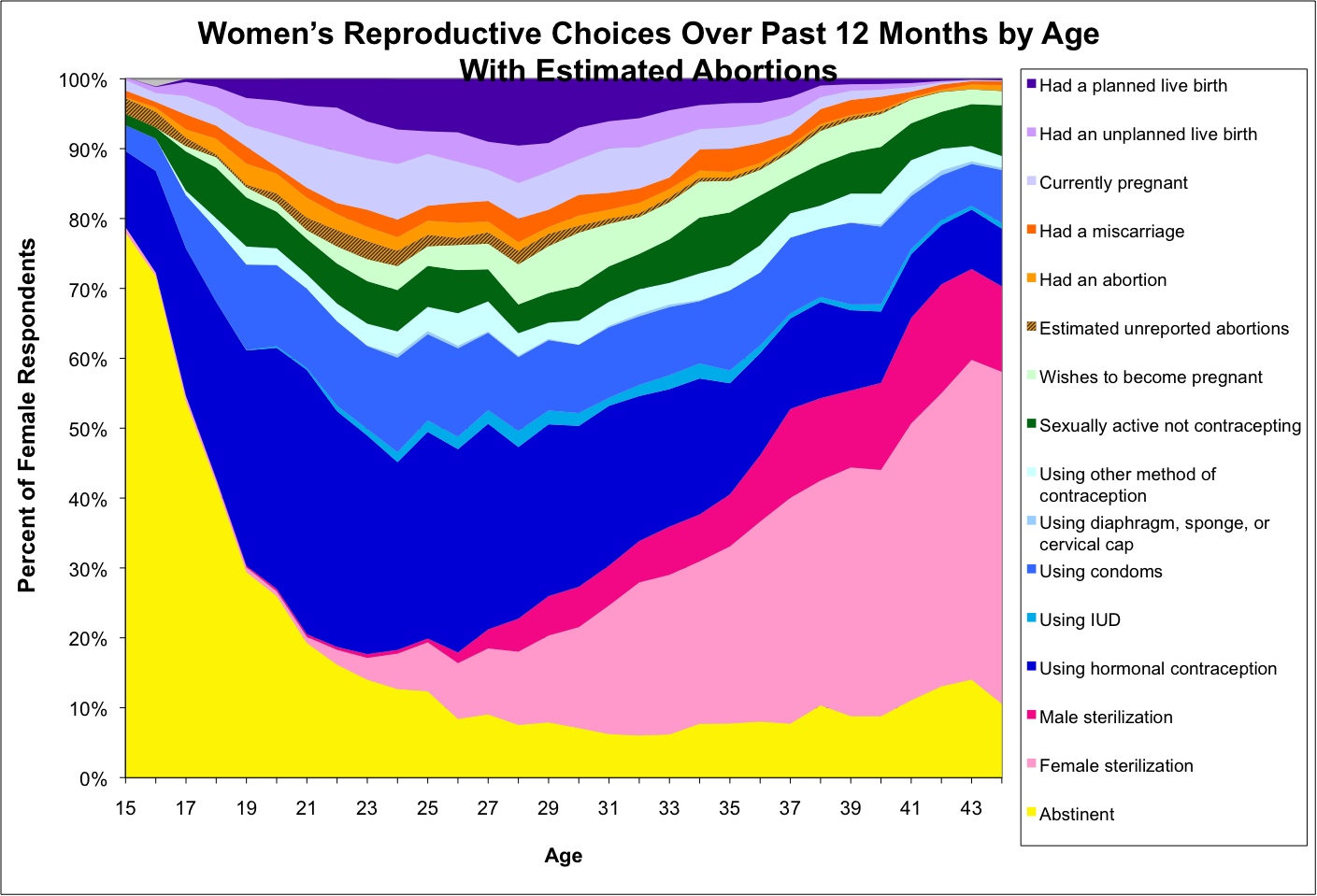
Estimating unreported abortions for Figure 1 produces a similar picture.[37]
Figure 1-EA (Estimated Abortions)
IV. Cumulative Pregnancy History
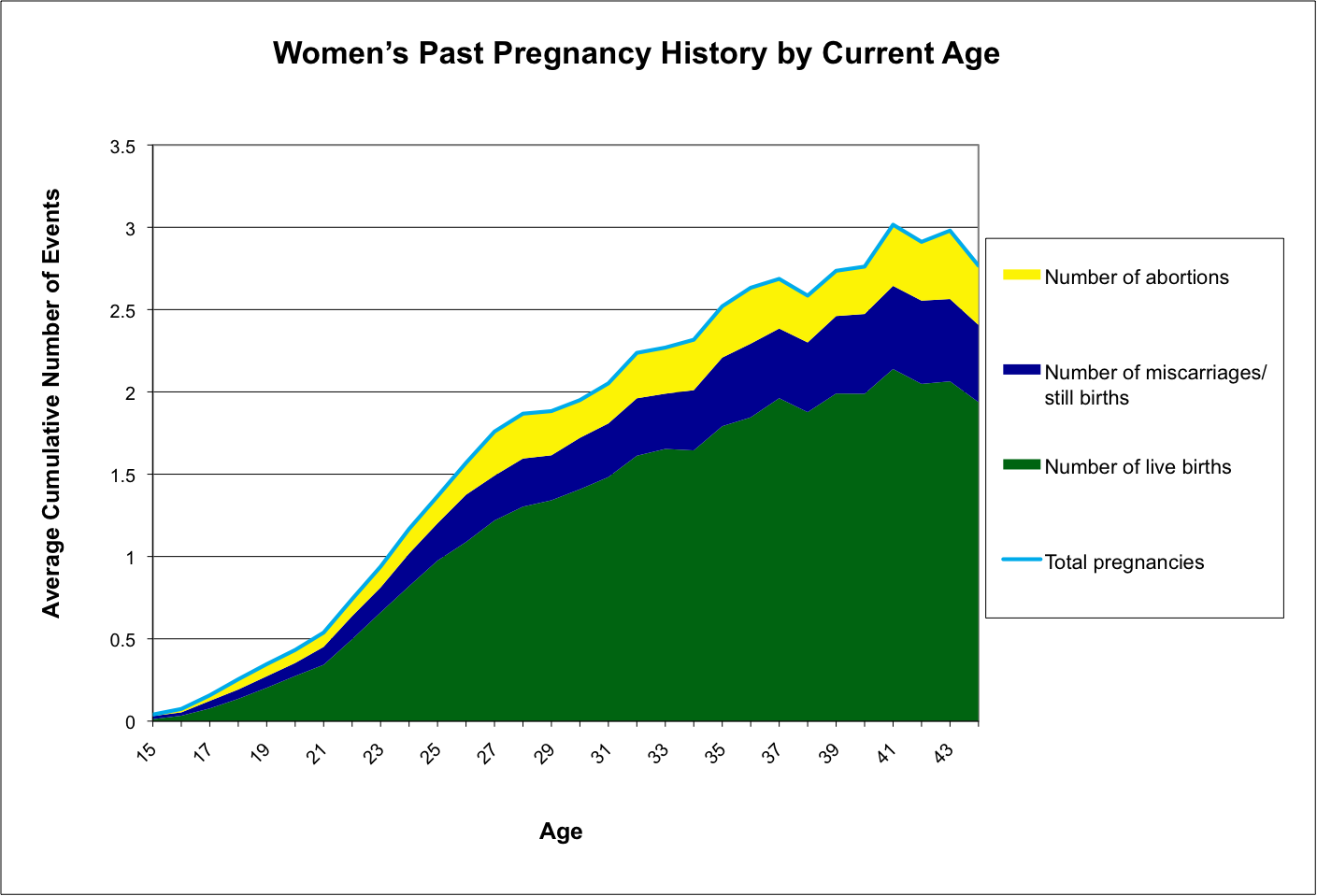
In the modern era, pregnancy represents a relatively small fraction of a woman’s fertile life. Greatly magnifying this portion of her experience, Figure 3 offers a picture of women’s cumulative pregnancy history, including births, experienced miscarriages and stillbirths, and abortions.[38] It is derived from the smoothed NSFG data in Figure 2-S. But unlike Figure 2-S, Figure 3 does not report pregnancy events by year. Rather, it pictures the average cumulative experience of women at each age in the NSFG sample.[39] It illustrates that a relatively significant portion of pregnancies do not end in a live birth.
Figure 3
V. From Generation to Generation
Using cohort data, Figure 1 emphasizes the procreative project of women in one generation. However, the autonomous regulation of fertility takes place within a web of relationships.
Reproduction always necessarily entails a relationship with a male. Representing relationships with a fertilizing man, married or unmarried, of long or short duration, at arm’s length (involving the social relationship of sperm purchase or gift) or in arms’ embrace, presents so many complexities, no picture is attempted.
Procreation also entails the interrelationship of successive generations of daughters and mothers, weaving together, into an intergenerational project, knowledge and lore, expectations and admonitions, practices and constraints, care and wisdom.[40] Thus, imagine that a twenty-one-year-old woman (whose mother was born in 1895) birthed a girl in 1936 who, at the age of twenty-two in 1958, birthed a girl who, at the age of twenty-four in 1982,[41] birthed a girl: the mother and child below.[i] That mother, a possible participant in the NLSY79 survey pictured in Figure 1-EA, was forty-four at the time of the NSFG survey, pictured in Figure 2-S-EA. By then, she was coming to the end of the fertile period of her sexual life. Her sexually active mother was postmenopausal but still married at sixty-six, and her grandmother was alone and widowed at eighty-seven. Her twenty-year-old daughter was already more than six years into her project of regulating her procreative power. A picture of such maternal intergenerational relationships, more complex than Figures 1-EA and 2-S-EA, would illustrate the overlapping ubiquity of fertility and its self-control.

*Professor of Law, UCLA School of Law. Sarah E. Edgington played a crucial role in developing and implementing the data analysis, and Eunice Muthengi Karei elaborated on it and brought the analysis to completion. With intellectual vivacity, Reva Siegel and Robert Post provided an occasion for this work at the 2008 Yale Law School conference “The Future of Sexual and Reproductive Rights.” Thanks to Joe Doherty, Director of UCLA Law School’s Empirical Research Group for his intellectual and financial support, to UCLA Law School’s wonderful librarians, to Anne Pebley of UCLA’s School of Public Health, and to Joseph Goldstein, Rick Sander, and Wendy Schmelzer for reading drafts.
[2]. Griswold v. Connecticut, 381 U.S. 479, 486 (1965); see generally Loving v. Virginia, 388 U.S. 1 (1967) (finding that a ban on interracial marriage violated the Equal Protection and Due Process Clauses, thereby deregulating the evolution of the “races” by leaving their future to individual reproductive choice); Pierce v. Soc’y of Sisters, 268 U.S. 510 (1925); Meyer, 262 U.S. 390.
[3]. Prince v. Massachusetts, 321 U.S. 158, 166 (1944). The state may go “very far, indeed,” Meyer, 262 U.S. at 401, in setting the rules for socializing children. However, Meyer, 262 U.S. at 401–02, expressly contrasts the U.S. Constitution’s model with that of state guardians overseeing the upbringing of children to ensure the interests of the state, as in Plato’s Republic and in the city-state of Sparta. Only one generation later, the Court could have as easily contrasted its approach with the totalitarian model in Nazi Germany, George Orwell’s 1984, and Aldous Huxley’s Brave New World. Cf. Jed Rubenfeld, The Right of Privacy, 102 Harv. L. Rev. 737 (1989).
[4]. See Robert D. Goldstein, Child Abuse and Neglect (1999); see also Robert D. Goldstein, Mother-Love and Abortion (1988).
[5]. See, e.g., Carey v. Population Servs. Int’l, 431 U.S. 678 (1977); Roe v. Wade, 410 U.S. 113 (1973); Eisenstadt v. Baird, 405 U.S. 438 (1972); Loving, 388 U.S. 1; Griswold, 381 U.S. 479. Casey augmented this understanding by recognizing that these choices of intimate association involve not only shaping a social life with others but also forging an identity that goes to the very core of the self. Planned Parenthood of Se. Pa. v. Casey, 505 U.S. 833, 851 (1992) (describing “the right to define one’s own concept of existence . . . and of the mystery of human life”); see Lawrence v. Texas, 539 U.S. 558 (2003) (“Liberty presumes an autonomy of self that includes freedom of thought, belief, expression and certain intimate conduct.”).
[7]. Without regard to original intent or meaning, text, structure, precedent, prudential arguments, or the like, the Court writes in District of Columbia v. Heller:
It is no answer to say, as petitioners do, that it is permissible to ban the possession of handguns so long as the possession of other firearms (i.e., long guns) is allowed. It is enough to note, as we have observed, that the American people have considered the handgun to be the quintessential self-defense weapon. There are many reasons that a citizen may prefer a handgun for home defense: It is easier to store in a location that is readily accessible in an emergency; it cannot easily be redirected or wrestled away by an attacker; it is easier to use for those without the upper-body strength to lift and aim a long gun; it can be pointed at a burglar with one hand while the other hand dials the police. Whatever the reason, handguns are the most popular weapon chosen by Americans for self-defense in the home, and a complete prohibition of their use is invalid.
Id. at 2818. Similarly, in his concurring opinion in International Society for Krishna Consciousness, Inc. v. Lee, 505 U.S. 672, 693–95 (1992), Justice Kennedy criticizes the majority’s public forum analysis for its failure to account for people’s “actual” or “customary uses” (quoting his concurrence in United States v. Kokinda, 497 U.S. 720, 737–38 (1990)) of government property for speech purposes. Less explicitly, Roe v. Wade, 410 U.S. 113, turned on women’s actual use of abortion in the United States throughout history. Just as Justice Scalia was concerned with the disparate impact of a rule permitting long guns but not handguns on persons with less upper-body strength, Roe was concerned with the actual impact of abortion regulation on women vis-à-vis men, and poor women vis-à-vis those with more material resources. See id. at 121.
[8]. This use of this phrase differs from other invocations that have explored the impact of rights discourse on traditional mores or the struggle among anthropologists between respecting traditional practices that others, such as international human rights groups, depict as violative of human rights norms.
[9]. See Edward R. Tufte, The Visual Display of Quantitative Information (2d ed. 2001); see also Edward R. Tufte, Beautiful Evidence (2006); Edward R. Tufte, Envisioning Information (1990); Edward R. Tufte, Visual Explanations: Images and Quantities, Evidence and Narrative (1997).
[10]. Starting in 1982, women were asked about the number of births and the dates of those births since the previous interview. Questions pertaining to whether the respondent was contracepting before the pregnancy and whether she wanted to become pregnant determine whether a birth is identified as the result of an intended or unintended pregnancy. An intended birth is one in which a woman reports wanting to get pregnant or that it “didn’t matter.” For about 8 percent of births, the respondent provided a birth date but no intention status. For these missing intention status cases, it is assumed that the distribution of intended and unintended births is the same as the distribution of births with known intention status.
[11]. Miscarriages and stillbirths are treated here as a single category. Women were asked to provide dates of pregnancies since the last interview (typically two years) that did not end in live births or abortions. Where women reported a higher number of pregnancies not resulting in live births than provided dates for them, dates were imputed (both for miscarriages/stillbirths and abortions) by assigning a random date since the last interview. The chance of assigning a missing date to the correct year is 50 percent (unless the woman missed the previous survey).
Reported miscarriages are necessarily those known by the woman. By definition, this category does not include: (1) fertilized ova prior to pregnancy that do not implant in the uterus; (2) spontaneous abortions after implantation but prior to a woman’s recognition of pregnancy; or (3) ectopic or molar pregnancies. See Morton A. Stenchever et al., Comprehensive Gynecology 414–34 (4th ed. 2001). All miscarriages, unknown and known (a clinical pregnancy), are estimated by some to be approximately 32 percent of all fertilizations. See generally infra note 38. It should be recognized that abortions reduce the number of identified miscarriages and stillbirths that would otherwise have occurred. See R.J. Gandy, An Estimate of the Effect of Abortions on the Stillbirth Rate, 11 J. Biosoc. Sci. 173 (1979).
[12]. Beginning in 1982, a series of questions were asked in even-numbered years to determine whether and how women were contracepting. First, women were asked whether they used any method of birth control to prevent pregnancy. If they responded affirmatively, then they were asked to choose from a list which methods they had used in the previous month. Responses were categorized in the following way: hormonal methods (including the pill, Norplant, or Depo-Provera); IUD (including all IUDs); condom (including male and female condoms); diaphragm, sponge, cervical cap (including barrier methods with or without spermicidal jelly or cream, sponge, or cervical cap); and other methods (including foam, spermicidal cream or jelly used without an additional method, douching after intercourse, withdrawal, periodic abstinence [for example, “natural family planning,” including determining the “safe time” using calendar, temperature, or cervical mucus], or a response of “other method”).
Questions about contraception were only asked in even-numbered years and 1985. In contrast, information on pregnancy outcomes was collected with dates for all years. To avoid effectively halving the sample size for each age by ignoring pregnancy data from odd-numbered years, women who reported using a contraceptive method are assumed to have also used that method in the previous year. That is, if a woman reported using a hormonal method in 1992, she is assigned to that category of method in 1991 as well.
In Figure 1 and subsequent figures, contraceptive methods are arranged vertically from most to least effective, with the most effective nearest the x-axis. Failure rates are based on the method’s likelihood of a pregnancy in the course of a year.
[13]. Before 2002, respondents were asked about surgical sterilization as part of the series of questions on contraceptive method. From 2002 onward, respondents were asked about sterilization separately: whether they, or their partner, had been surgically sterilized. Also, those who in any year reported being sterilized were not asked questions about contraception in subsequent years. It is assumed that women who reported female sterilization as a contraceptive method continue to be sterilized in all subsequent years. However, because women who reported male sterilization in an early interview could later switch male partners, no assumptions are made about those later years.
[14]. Some respondents reported more than one reproductive event in a given year. For instance, a woman may have experienced a miscarriage early in the year and a live birth at the end of the year. So that the total percentage of women in all categories would not exceed 100 percent per year, Figure 1 assigns each woman to only one category per year, according to the following order of priority to minimize undercounting of abortion: abortion, birth, miscarriage and stillbirth, abstinence, female sterilization, male sterilization, and contraceptive use. Thus, a woman who reported both an abortion and a miscarriage in a given year is counted only in the abortion category. This methodological exclusion does not lead to substantial undercounting for any category. If such double counting were permitted, it would occur in most categories in fewer than 2 percent of cases in any given year and in no particular direction (data related to double-counting on file with author and UCLA Law Review). Despite the priority of abortion in the rule of assignment, the data may understate the abortion rate, as discussed in Part III, infra.
This approach slightly undercounts births by counting the number of women who give birth in a year rather than the number of births (thus not counting multiple births from one pregnancy or two pregnancies within one year). The graph shows a total birthrate of about 1.87, although current data suggest a birth rate at or near population replacement (that is, 2.1).
|
#Respondents |
Acts of Intercourse/Month (circa per ovulatory cycle) |
Percent |
Estimated Average/Week |
|
1018 |
0 |
21% |
0 |
|
1265 |
1 to 4 |
26% |
1 |
|
1017 |
5 to 9 |
21% |
2 |
|
765 |
10 to 14 |
16% |
3 |
|
666 |
15 to 29 |
14% |
3+ |
|
116 |
30+ |
2% |
7+ |
[16]. The fertile fraction of the lifespan is dependent on the period of fertility, as the numerator, and the lifespan, as the denominator. In the last century, the change in the size of the denominator has greatly outstripped the change in the numerator due to the increase in the lifespan after menopause. See Elizabeth Arias, Ctr. for Disease Control, National Vital Statistics Reports: United States Life Tables, 2004, at 34–35 tbl.12 (2007), available at http://www.cdc.gov/nchs/data/nvsr/
nvsr56/nvsr56_09.pdf (showing that the average female life expectancy was 49.1 years in 1904 and was projected to be 80.4 in 2004).
With respect to the numerator, the period of fertility is thirty to thirty-five years. While Figure 1 shows an end to childbirth at age forty-five in the studied population, menopause (leaving aside a few controversial cases of assisted reproduction) sets the end limit for fertility. The average age of onset of menopause is 51.4; and, while there is uncertainty, some assert that that age appears to have remained fairly stable over time in healthy populations. Vera Bittner, Menopause and Cardiovascular Risk, 47 J. Am. C. Cardiology 1984 (2006). But over the last 150 years, there certainly has been a very substantial decline in morbidity, mortality, and sterility from childbirth and illegal abortion, enabling women to survive in health to their natural menopause.
A focus on menopause should not diminish awareness that fecundability (the likelihood of a pregnancy in a given time, usually one cycle) begins to diminish gradually between ages twenty-seven and thirty, rapidly by thirty-five, and is in sharp decline by age forty. Furthermore, miscarriage of recognized pregnancies greatly increase from 10 percent until age twenty-nine, to 18 percent at ages thirty-five to thirty-nine, to 34 percent by forty to forty-four, and to 53.2 percent by forty-five. Paul R. Gindoff & Raphael Jewelewicz, Reproductive Potential in the Older Woman, 46 Fertility & Sterility 989 (1986); but cf. David B. Dunson et al., Increased Infertility With Age in Men and Women, 103 Obstetrics & Gynecology 51, 53 (2004) (stating that the reduced frequency of intercourse from two or three times to once per week greatly reduces fertility); Jane Menken et al., Age and Infertility, 233 Science 1389 (1986) (warning against emphasizing decline of fertility before age forty, especially because by the end of the second year of trying, many couples who were defined as infertile after one year have conceived).
Menarche sets the numerator’s beginning limit, with the onset of fertility from several months to several years thereafter. It is clear that the onset of menarche now begins at an earlier age (from sixteen to eighteen in 1850 to under thirteen now), thus increasing the length of the fertile period and the size of the numerator. Figure 1 begins its picture at age seventeen.
Between the outer limits of menarche and menopause (or earlier sterility) are events that temporarily interrupt fecundability. These are primarily pregnancy itself, the postpartum period, and lactation (if it is the almost exclusive source of food, especially if on demand). As the number of lifetime pregnancies has fallen in the transition from traditional to modern families, and as the period of exclusive breastfeeding has diminished or disappeared, women are fecund for far more of their fertile life. Further, interruptions of fertility due to poor nutrition and health have also diminished; and over the last century, a husband’s increasing good health and survival chances during the wife’s fertile years also have the effect of increasing her fertility. See generally R.V. Short, The Evolution of Human Reproduction, 195 Proc. Royal Soc’y London, Series B 3 (1976); but cf. Dorothy McLaren, Nature’s Contraceptive, Wet-Nursing and Prolonged Lactation: The Case of Chesham, Buckinghamshire, 1578–1601, 23 Med. Hist. 426 (1979). All these changes have greatly increased the importance of methods of birth control.
[17]. For further discussion, see infra note 34.
[18]. William D. Mosher et al., Use of Contraception and Use of Family Planning Services in the United States: 1982–2002, CDC Advance Data From Vital & Health Stats., Dec. 10, 2004, at 17 tbl.4, available at http://www.cdc.gov/nchs/data/ad/ad350.pdf (percentage of women currently using periodic abstinence method of contraception: 0.7 percent use the calendar method and 0.2 percent use natural family planning); id. at 15 tbl.1 (lifetime use of periodic abstinence: 16.2 percent use the calendar method and 3.54 percent use natural family planning).
[19]. Abortion is primarily employed to terminate unwanted pregnancies: Half of all pregnancies described as unintended end in abortion. In one study of those having abortions, unintended pregnancies were due to: not using any birth control in the month of conception, not making correct and consistent use of birth control, and the failure of the birth control method itself. See Rachel K. Jones et al., Contraceptive Use Among U.S. Women Having Abortions in 2000–2001, 34 Persp. on Sexual & Reprod. Health 294, 296 tbl.1 (2002); cf. Cicely Marston & John Cleland, Relationships Between Contraception and Abortion: A Review of the Evidence, 29 Int’l Fam. Plan. Persp. 6, 11 (2003) (noting that contraception and abortion rates may rise together only during transitions from traditional large-family societies to modern small-family societies).
Some of these unintended pregnancies result from coerced sex. One study estimated 25,000 unwanted pregnancies resulted from rape in 1998. Felicia H. Stewart & James Trussell, Prevention of Pregnancy Resulting From Rape: A Neglected Preventive Health Measure, 19 Am. J. Preventative Med. 228, 228 (2000); see also Jones et al., supra, at 300 tbl.6 (estimating that among those condom-using women having abortions, 1.3 percent resulted from nonuse of contraception as a result of unwanted sex). Moreover, it is clear that there are many circumstances short of what would be legally defined as rape where women experience strong pressure that interferes with their autonomous choice regarding intercourse and contraception.
Abortion is employed even with intended pregnancies to protect the life and health of the woman, respond to fetal health and genetic problems, and address the loss of relationship with a putative father, or other reversals. As pregnancy-related health problems and the risk of genetic defects rise substantially with a woman’s age, the uses of abortion also change. For example, the risk of Down’s syndrome increases from 1/1250 pregnancies at age twenty-five, to 1/378 at thirty-five, to 1/106 at forty, to 1/11 at forty-nine. Other even more serious chromosomal abnormalities add to the likelihood of abortion. Am. Soc’y for Reproductive Med., Age and Fertility: A Guide for Patients 6 (2003).
[20]. In one study, 61 percent of abortions involved women with at least one child, 78 percent of the women were in their twenties and thirties, and 17 percent were married. Jones et al., supra note 19, at 295. Minors accounted for only 7 percent of abortions. Stanley K. Henshaw & Kathryn Kost, Trends in the Characteristics of Women Obtaining Abortions, 1974–2004 (2008), available at http://www.guttmacher.org/pubs/2008/09/23/TrendsWomenAbortions-wTables.pdf. Perhaps one-third of all women will have an abortion in their lifetime. Id. at 15. See generally Reva B. Siegel, Dignity and the Politics of Protection, 117 Yale L.J. 1694 (2007) (criticizing a “women protective” theory of abortion regulation); Robert D. Goldstein, Reading Casey: Structuring the Woman’s Decision-Making Process, 4 Wm. & Mary Bill Rts. J. 787 (1996).
[21]. Pope John Paul II equated sterilization, abortion, and most other contraceptive methods as immoral acts that similarly disaggregate the asserted unity of each sexual act with procreative potential and, for that reason, similarly reflect a “culture of death.” See generally John Paul II’s Contribution to Catholic Bioethics (Christopher Tollefsen ed., 2004).
[22]. Abortion remains a comparatively rare method, even after taking higher estimates into account in Part III, infra.
[23]. Assisted reproduction (AR), if it involves egg extraction, remains an extraordinarily expensive and problematic possibility. The picture painted here does not take into account specific data on AR, nor does it make room for the normative possibilities (both for heterosexual and exclusively homosexual persons) that some see in this technology. As with “unassisted” reproduction, the chances of successful AR after a woman turns thirty-five quickly decline.
[24]. Methodological difficulties may have left the content of these categories more opaque than necessary, as is discussed in Part II, infra. One can hypothesize that these categories contain various subgroups of women who have diverse normative beliefs about procreative choice, who are unsure of their procreative purposes, who are not contracepting because they are trying to become pregnant, and who are not sexually active.
These categories presumably also contain women whose procreative autonomy is affected by various external and internal conditions, including lack of material resources for contraception; lack of knowledge; pressures from partners, parents, and others; or mental conditions that interfere with planning (such as depression, retardation, or ADD). The interference of external circumstances with procreational autonomy is suggested by NSFG data that show a strong association of unwanted and mistimed births with increasing poverty, decreasing education, and decreasing age of first intercourse below twenty. See CDC Nat’l Ctr. for Health Statistics, Fertility, Family Planning, and Reproductive Health of U.S. Women: Data From the 2002 National Survey of Family Growth tbls.20–21, 37–39 (2005); see also Susan J. Zuravin, Unplanned Childbearing and Family Size: Their Relationship to Child Neglect and Abuse, 23 Fam. Plan. Persp. 155 (1991); Susan J. Zuravin, Unplanned Pregnancies, Family Planning Problems, and Child Maltreatment, 36 Fam. Rel. 135, 138 (1987).
[25]. Cycle 6 of the NSFG survey is described as follows:
Cycle 6 (2002): A Survey of Men and Women, 2002: Cycle 6 of the National Survey of Family Growth (NSFG) was conducted by the National Center for Health Statistics (NCHS), with the participation and funding support of nine other programs of the U.S. Department of Health and Human Services. Cycle 6 was based on an area probability sample. The sample represents the household population of the United States, 15–44 years of age. The survey sample is designed to produce national data, not estimates for individual States. The contractor for the survey, the Institute for Social Research Center of the University of Michigan, hired and trained over 200 female interviewers for the 2002 NSFG. In-person interviews were completed with 12,571 respondents 15–44 years of age—7,643 females and 4,928 males. The interviews were voluntary and confidential. The response rate was 79 percent overall—80 percent for females and 78 percent for males. The questionnaire for males averaged about 60 minutes in length, while the female interview averaged about 80 minutes.
Centers for Disease Control and Prevention, About the National Survey of Family Growth, http://www.cdc.gov/nchs/nsfg/about_nsfg.htm (last visited May 21, 2010).
In the survey, women were asked about the dates and outcomes (birth, stillbirth and miscarriage, and abortion) of all previous pregnancies. However, Figure 2-S only uses information from pregnancies that occurred within the twelve months before the interview. Live births are categorized as intended or unintended pregnancies by self-report.
In Figure 2-S, double counting events is avoided the same way as in Figure 1. See supra note 14. Priority of assignment is given in the following order: abortions, live births, and miscarriages. The NSFG data set already assigned women who did not have a pregnancy during a given year into mutually exclusive categories based on sexual activity and contraceptive use. If permitted, double counting would have occurred on most variables in fewer than 2 percent of cases in any given year, and the exclusion shows no particular direction. Thus, the exclusion does not lead to substantial undercounting for any category. Despite the priority of abortion in the rule of assignment, the data may understate the abortion rate, as discussed in Part III, infra.
[26]. The three-year moving average was constructed by averaging the percentage of women in each category at ages n, n–1, and n+1. Of special note with respect to cell size, there were only forty-seven responses by women below age eighteen.
Figure 2 (unsmoothed NSFG data)
[28]. One minor difference between the two figures is that, unlike Figure 1, in Figure 2-S, the male and female sterilization category includes sterility not resulting from contraceptive-motivated surgery.
[29]. The hypothesis is that if the two different methodologies of NLSY79 and NSFG were employed to elicit information from the same sample, then indeed the respondents would shift from one group to another; however, in fact the two different methodologies are used to elicit information from two different samples.
[30]. William Mosher et al., Sexual Behavior and Selected Health Measures: Men and Women 15-44 Years of Age, United States, 2002, CDC Advance Data From Vital & Health Stats., Sept. 15, 2005, at 1, available at http://www.cdc.gov/nchs/data/ad/ad362.pdf.
[31]. While data are reported as if a woman uses only one birth control method, 10 percent of studied women used multiple methods in the same month, either conjointly or alternatively, especially when reporting use of “other methods.” Thus, a couple may occasionally join a diaphragm or condom with rhythm, or use withdrawal when another method is unavailable. This is especially common among married and cohabiting couples. Similarly, an unmarried woman may require a male condom for disease protection joined with another method for pregnancy prevention. See Mosher et al., supra note 18, at 11 tbl.B, 25 tbl.14; Rachel K. Jones et al., Better Than Nothing or Savvy Risk-Reduction Practice? The Importance of Withdrawal, 79 Contraception 407 (2009).
The list of contraceptives does not include lactation. This is the case although “[t]hroughout the world as a whole, more births are prevented by lactation than all other forms of contraception put together.” See Short, supra note 16, at 17. By assigning women to only one category, the picture assigns some women who, during a year, enjoy contraceptive protection through lactation, to the categories of “gave birth,” “currently pregnant,” and “abstinent;” the remainder may be found in the “noncontracepting sexually active” or “trying to get pregnant” categories. Since the lactating contraceptive effect is most pronounced in the first six months after birth and in those women who are the exclusive source of nutrition, the absence of lactation as a separate category probably does not alter the overall picture. The NSFG survey does contain a category of one-month postpartum at the time of the interview, but this is not useful in a picture that assigns respondents to year-long categories. The sample also contains a category for duration of breastfeeding but no attempt was made to ascertain the relationship of this category to contraceptive use. CDC Nat’l Ctr. for Health Statistics, supra note 24, at 117 tbl.78.
In the NSFG data, the most prevalent currently used form of female birth control is the pill, with sterilization second. The most commonly ever used contraceptive is the male condom (90 percent), followed by the pill (82 percent), withdrawal (56 percent), female sterilization (21 percent) and injectables (17 percent). Noteworthy in the NSFG data series is the great increase in the use of the condom (from 52 percent in 1982 to 90 percent in 2002) and in the use of withdrawal (25 percent in 1982 to 56 percent in 2002). Also noteworthy is the increase in the use of any method at first intercourse from 45 percent before 1980 to 79 percent between 1999 and 2002. Whether this (and the introduction of emergency contraception) accounts for the drop in the abortion rate in the 1990s requires further study. See Mosher et al., supra note 18, at 1; Marston & Cleland, supra note 19.
Among female NSFG respondents, 29.58 percent currently identify as Catholic, 50 percent as Protestant, 5.89 percent as “other,” and 14.52 percent as “no religion.” For religious identification of those using contraceptive devices, see CDC Nat’l Ctr. for Health Stat., supra note 24, at 93 tbl.54. Cf. Guttmacher Inst., Facts on Induced Abortion 1 (2008) (religious identification of those obtaining abortions: 27 percent Catholic, 43 percent Protestant).
[32]. A CDC study by Mosher classifies about 69 percent of NSFG women (ages 15–44) as at risk of unintended pregnancy: 62 percent who were contracepting plus 7.4 percent who were sexually active, not contracepting, and not intending to become pregnant. He identifies the remaining 30.7 percent of women as not at risk of unintended pregnancy because they were trying to become pregnant (4.2 percent), pregnant or postpartum (5.3 percent), sterile for noncontraceptive reasons (surgically 1.5 percent plus nonsurgically 1.6 percent), or recently (at least the last three months) abstinent (18.1 percent). Mosher et al., supra note 18, at tbls.4, 6–8.
The percentage of contraceptors rises with the number of children women have borne and especially among those who have reached their desired family size. Id. at 21 tbl.9. Mosher reports:
About 89 percent of all women at risk of unintended pregnancy [contraceptors plus non contraceptors who had intercourse in last three months without intending to get pregnant] were using contraception at the date of the interview. Among those who are delaying their next birth (those who intend to have another child in the future), 86 percent were using contraception. Of those at risk of unintended pregnancy who have had all the children they want and do not intend any more children in the future, 92 percent were using contraception.
Id. at 8.
[33]. Related methodological issues exist for a smaller number of women in the Figure 1 categories of married and cohabiting women with no contraceptive method reported.
[34]. Lawrence v. Texas, 539 U.S. 558 (2003), which found a law criminalizing oral and anal same-sex acts unconstitutional, does not explain its holding, though it could have, as a straightforward and direct application of Griswold v. Connecticut, 381 U.S. 479 (1965), and Eisenstadt v. Baird, 405 U.S. 438 (1972), to other forms of birth control.
[35]. An additional 3.1 percent report having had a same-sex experience in the prior year but not exclusively so.
[36]. See Lawrence B. Finer & Stanley K. Henshaw, Disparities in Rates of Unintended Pregnancy in the United States, 1994 and 2001, 38 Persp. on Sexual and Reprod. Health 90, 93 tbl.1 (2006); Haishan Fu et al., Measuring the Extent of Abortion Underreporting in the 1995 National Survey of Family Growth, 30 Fam. Plan. Persp. 128 (1998); Stanley K. Henshaw, Unintended Pregnancy in the United States, 30 Fam. Plan. Persp. 24, 26 (1998) (estimating that the actual number of abortions was 56 percent higher than that reported in the NSFG surveys between 1976 and 1994).
The methodology for eliciting abortion reports in the NLSY79 survey may have contributed to this difference, although the magnitude of the effect is unclear, given the analogous underreporting in the NSFG survey. Until 2002, NLSY79 respondents (in in-person interviews) answered questions on abortion by way of a confidential abortion data card, which they filled out themselves. Starting in 2002, those questions were added to the regular interview. Moreover, beginning in 2002, the majority of interviews were administered by phone. While most interviews had been conducted in person until 2002, some interviews each year had been conducted via telephone either because the respondent preferred a telephone interview or because budget constraints precluded travel for in-person interviews. Through 1996, fewer than 15 percent of interviews were conducted by telephone each year (with the exception of the 1987 round of interviews). After 1996, the proportion of telephone interviews increased each year.
[37]. Figure 1-EA provides a hypothetical look at the NLSY79 cohort of women on the assumption that its abortion rate approximates the generally accepted national rate. In order to estimate the percentage of respondents who had an abortion in a given year but did not report it, the percentage of women who reported an abortion at each age was subtracted from Finer and Henshaw’s reported rate, and the difference was used as a hypothesized unreported abortion rate. Because abortion rates declined overall between 1980 and 2000, the 1980 rate was used to adjust the reported number of abortions until 1994; and the 2000 rate was used to adjust the number of abortions for all years after 1994. Adding the estimated unreported abortions to the graph required reducing the size of other categories. The respondents most likely to have had an unreported abortion were assumed to be those at the highest risk of unintended pregnancy: those who reported no contraceptive use in a relationship or reported using one of the less reliable “other methods” of contraception. Two-thirds of the estimated unreported abortions were subtracted from the two no-contraceptive-choice-with-partners categories, proportional to actual reported marital and cohabitation status at that age. (This method omits subtracting unreported abortions from the noncontracepting-single category). The remaining one-third of the estimated unreported abortions were subtracted from the “other methods” category.
[38]. One could try to graph the total number of fertilizations by adding to Figure 3 pre-pregnancy fertilizations that never implant, plus early pregnancy losses that occur before awareness of pregnancy.
Estimates of unimplanted fertilizations range from 30 to as high as 70 percent of all fertilizations. Studies of early pregnancy loss prior to recognized or clinical pregnancies (prior to about six weeks since last menstrual period) estimate an overall miscarriage rate of 32 percent with two-thirds to three-fourths of miscarriages occurring before clinical pregnancy. Interestingly, there is some evidence that such early loss is associated not with fertility problems, but with successful pregnancies that go to term within the next few ovulation cycles. See Xioban Wang et al., Conception, Early Pregnancy Loss, and Time to Clinical Pregnancy: A Population-Based Prospective Study, 79 Fertility & Sterility 577, 581–82 (2003) (32.5 percent of 618 conceptions miscarried, approximately 7.9 percent as spontaneous abortions of clinical pregnancies and 24.6 percent as early pregnancy losses; in addition, 1 percent of conceptions involved ectopic pregnancies (two cases) or still births (four cases)). See also N.S. Macklon et al., 8 Hum. Reprod. Update 333 (2002) (estimating 10 percent clinical miscarriages and 30 percent spontaneous abortions prior to clinical pregnancy); Allen J. Wilcox et al., Incidence of Early Loss of Pregnancy, 319 New Eng. J. Med. 189 (1988); Michael J. Zinaman et al., Estimates of Human Fertility and Pregnancy Loss, 65 Fertility & Sterility 503 (1996); cf. T. Chard, Frequency of Implantation and Early Pregnancy Loss in Natural Cycles, 5 Bailliere’s Clinical Obstetrics & Gynaecology 179 (1991).
[39]. Figure 3 takes the liberty of setting the scale of its y-axis as if the graph represents pregnancies of an average woman rather than events/1000 women.
While this graph does not distinguish married from unmarried women, in the NSFG data (of all surveyed ages) 18 percent of married women had not had a child, compared with 80 percent of women who had never married. Mosher, supra note 18, at 8 tbl.A. See generally Gilda Sedgh et al., Legal Abortion Worldwide: Incidence and Recent Trends, 39 Persp. on Sexual & Reprod. Health 216 (2007).
[40]. See generally Erik H. Erikson, Identity: Youth and Crisis 45 (1968) (“[S]ociety consists of generations in the process of developing from children into parents . . . .”); Erik H. Erikson, Childhood and Society (1950).
[41]. Each generation experiences fertility and exercises procreative powers under somewhat different conditions.
The grandmother experienced friends giving birth at a younger age, no hormonal contraceptives, abortions in a regime of illegality, suppressed and sometimes illegal contraceptive information, very limited sterilization procedures, a shorter period of fertility, and probably far more family and community scrutiny of her reproductive behavior.
During the 1980s, the mother experienced the terrors of the AIDS and STD epidemics, an IUD scare, a somewhat higher national abortion rate in her twenties, and a subsequent reduction of that rate in the next decade (possibly associated in part with greater use of emergency contraception and condoms at first intercourse), increasing postponement of the mother’s age at first birth, and the so-called “culture wars.”
[42].Francisco Zuñiga, Madre con nino en la cadera/Mother and Child at her Hip, 1979. Bronze. Franklin D. Murphy Sculpture Garden, University of California, Los Angeles. Gift of Lisa and Ernest Auerbach. Courtesy Hammer Museum.
